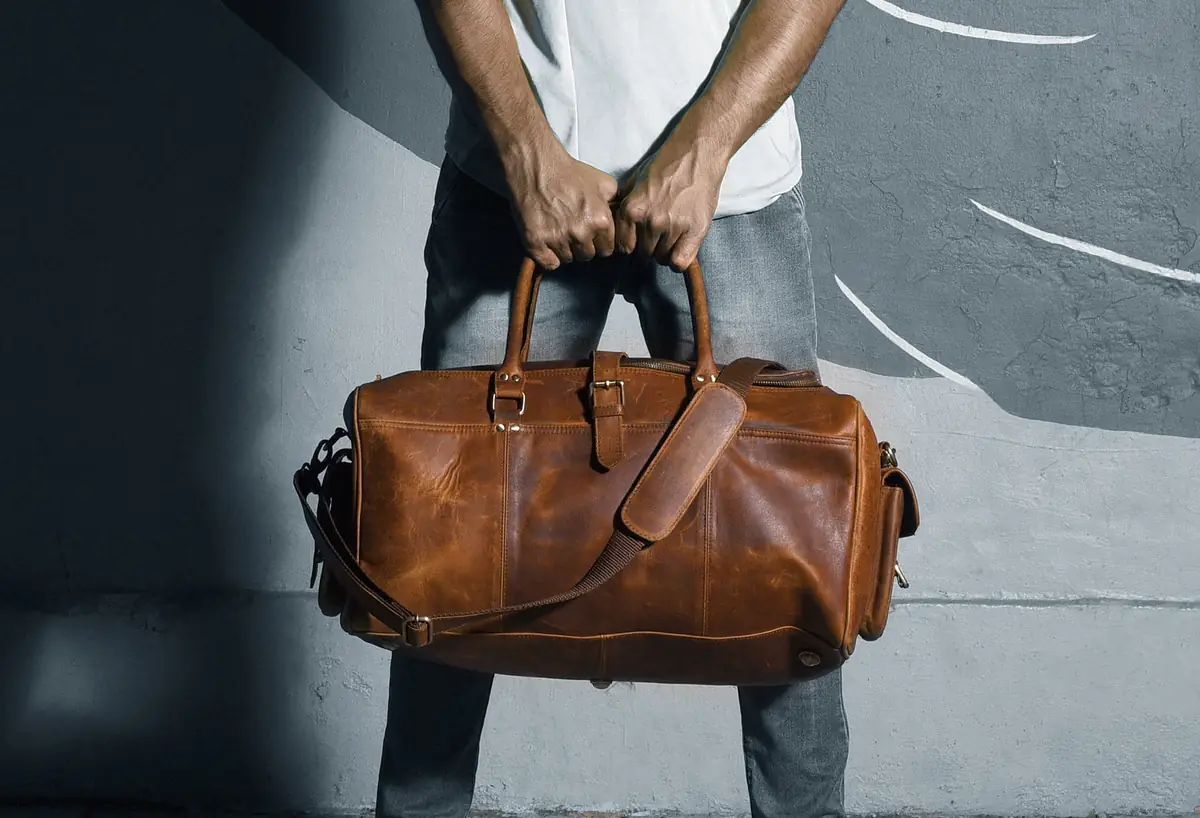
You can spot the wrong everyday bag for men from across the street. The hiking backpack over a wool overcoat, the tiny sling that no longer zips because a charger got forced into it, the stiff briefcase hauled all the way to Friday drinks. The problem is rarely taste. It's use: we buy a bag for the day we imagine, then carry it through the one we actually have.
What to keep in mind before you buy:
- Start from what you carry every day, laptop or no laptop.
- One good work bag beats three average ones.
- Full-grain leather and heavy nylon are the two materials that last.
- Match the colour to your shoes: black with black, brown with brown.
- Expect to spend $170 to $450 (roughly €150 to €400) on a leather work bag that will last for years.
Which bag suits which kind of day?
Before style, look at your calendar. A man who takes the train with a 14-inch laptop, lunch and a water bottle doesn't need the same bag as a man who walks to the office with a phone and a notebook. Six broad families cover almost every situation, and each has its own territory.
| Style | What it holds | Best for | Dress level | Typical price |
|---|---|---|---|---|
| Flat sling | Phone, wallet, keys | City, evenings, weekends | Casual | €40 to €200 |
| Messenger | 13 to 15-inch laptop, notebook, charger | Office, commute, all-rounder | Casual to smart | €80 to €400 |
| Backpack | Laptop, lunch, gym kit | Cycling, transit, long days | Casual | €70 to €350 |
| Briefcase | Slim laptop, A4 or letter files | Formal office, client meetings | Dressy | €150 to €600 |
| Tote | Anything, loose | Market, beach, creative office | Casual | €30 to €300 |
| Weekender (holdall) | Two to three days of clothes | Short trips, gym | Casual to smart | €100 to €500 |
The takeaway is simple: if you could own only one bag, it would be a medium-sized messenger. It carries by hand with a blazer, goes across the chest on Saturday, and swallows a laptop without looking like it. The backpack comes a close second for men who walk or cycle a lot.
What is the best everyday bag for men at the office?
This is the question that matters, because your work bag is the one you'll carry two hundred days a year. Three options hold up, depending on your dress code.
The briefcase, for formal workplaces
If you wear a suit at least three days a week, the briefcase is still the most coherent choice. Slim, rigid or semi-rigid, carried by the handle, it extends the line of the outfit instead of breaking it. A 38 x 28 cm model (about 15 x 11 in) with 7 to 8 cm of depth takes a 14-inch laptop and a folder. Go for smooth black or dark brown leather, with two gussets at most: beyond that it bulges like a suitcase. For the formal side of the equation, our guide on how to choose a suit covers the codes that go with it.
The messenger, for business casual
This is the modern office format. A messenger in pebbled leather or heavy nylon, with a flap or a zip top, works with chinos, an oxford shirt and a sweater. Its decisive advantage is that it offers two ways to carry: handle in the meeting, strap on the street. Check that the strap is detachable and adjusts over at least 30 cm. And that the flap closes one-handed.
The backpack, as long as it's clean
We have nothing against a backpack at the office. Quite the opposite: two straps spread the weight of a 1.5 kg laptop far better than one, and your back will notice after an hour of commuting. But it has to look like a city bag, not a trekking pack. Rectangular shape, matte fabric, no dangling compression straps, a single discreet front pocket. A black ballistic nylon or soft leather backpack sits over an overcoat without clashing.
What about weekends, the city and evenings out?
On Saturday the laptop stays home. The bag shrinks. A flat sling worn across the chest is enough for a phone, a wallet, keys and earbuds; the whole trick lies in the strap length, which we cover in our guide on how to wear a crossbody bag. A belt bag worn crossbody does the same job, only sportier. It looks great with a sweatshirt, far less so with a wool coat.
The tote, that big open bag with two handles, earns its place in summer and at the farmers' market. In heavy canvas it goes on the shoulder with a T-shirt and shorts; in soft leather it even makes it into the office in creative jobs. Its only flaw is built in: with no compartments, everything ends up at the bottom. Slip a zip pouch inside for small items.
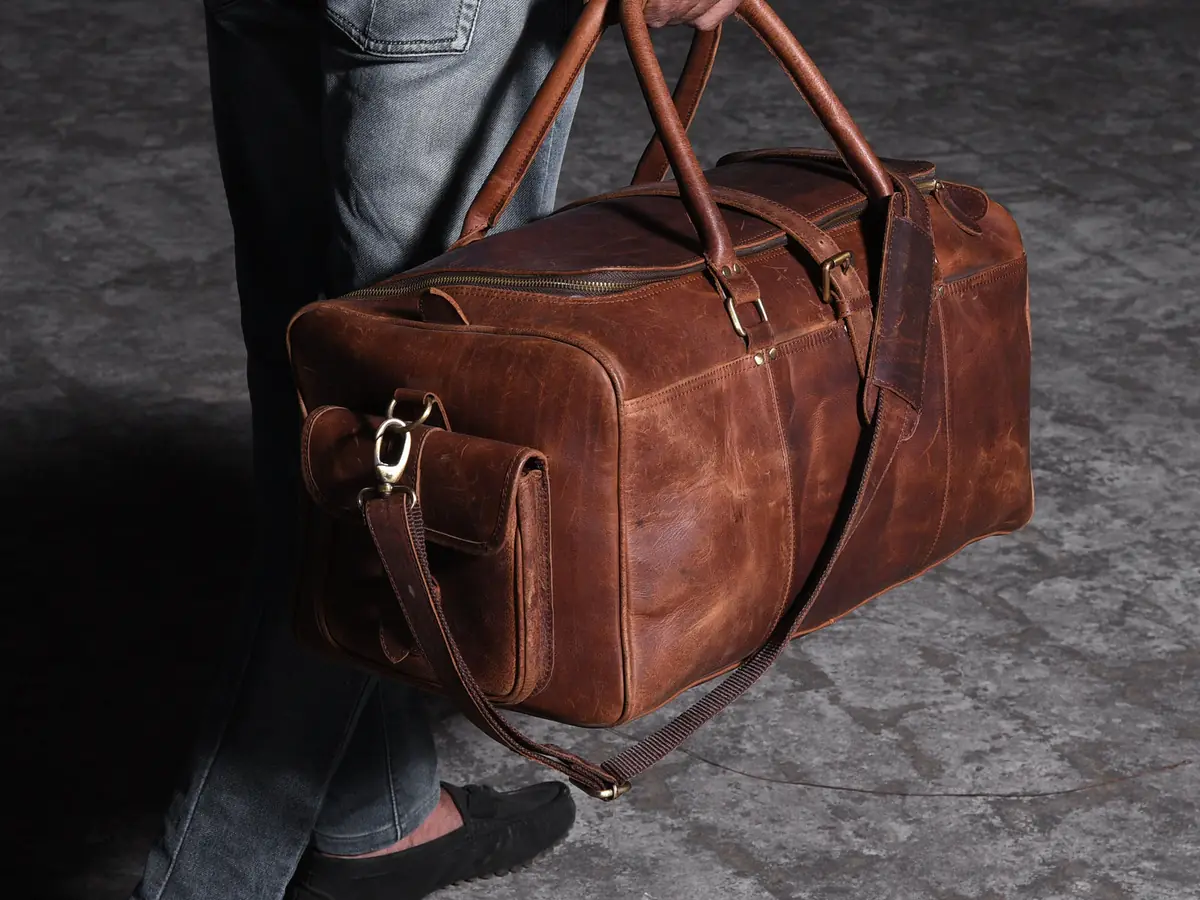
For a two- or three-night getaway, a weekender (or holdall) beats a carry-on suitcase. A model 45 to 55 cm long, about 35 to 45 litres, fits two outfits, a wash bag and a pair of shoes. Check your airline's cabin bag dimensions before you leave: they vary from one carrier to the next.
Leather, nylon or canvas: which material?
Material decides how long a bag lives far more than the label does.
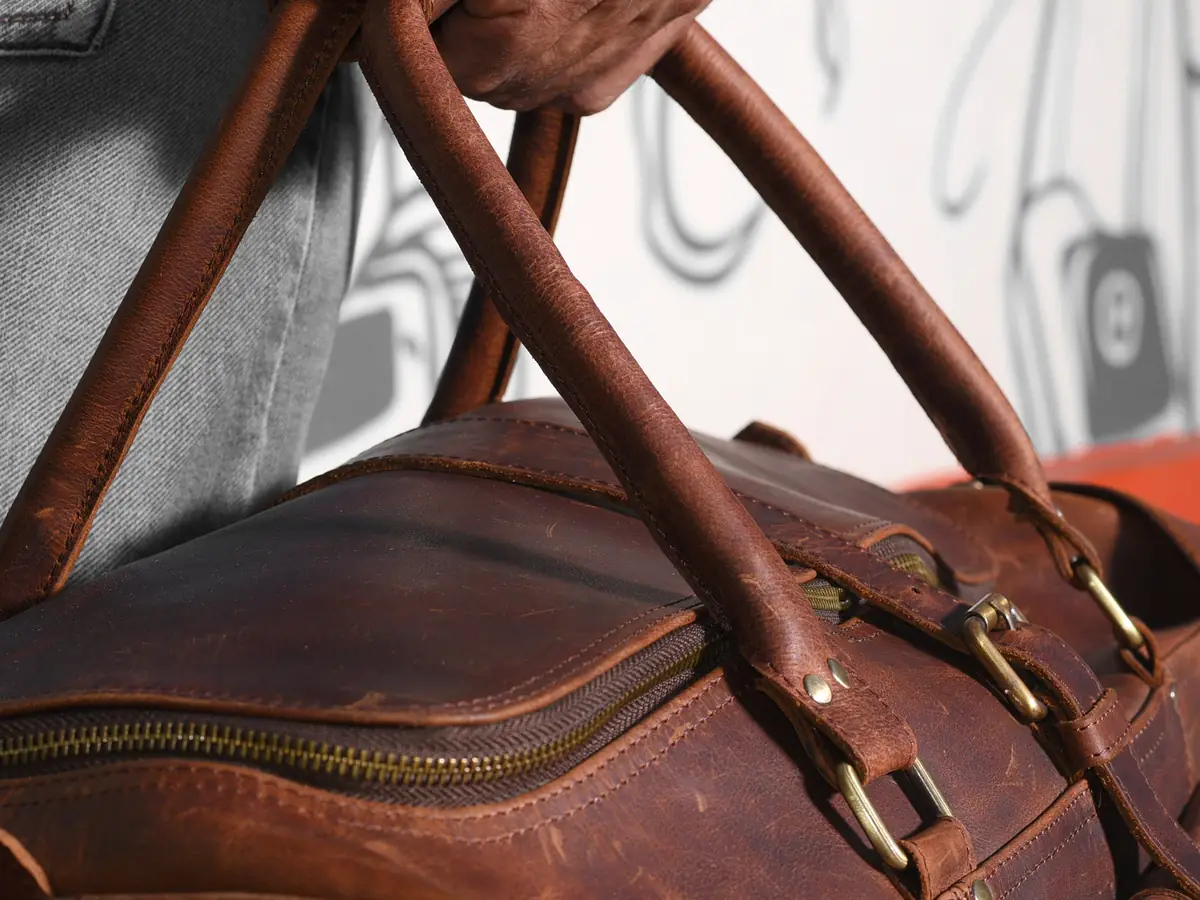
Full-grain leather is the top tier, the one that keeps the natural surface of the hide. It develops a patina, softens, and a well-made bag lasts ten years or more with a conditioning cream twice a year. Pebbled leather, more scratch-resistant, suits a work bag that gets knocked around on public transport. Read the label closely: "genuine leather" says nothing about the quality of the hide, and bonded leather (leather fibres pressed together) won't age like a whole skin. Split leather, thinner and more fragile, gives itself away by a slightly suede-like back.
Technical nylon has earned its place at the office. Ballistic nylon (often listed at 1050 denier) or a 500 to 1000 denier Cordura shrugs off rain, abrasion and years of use. It weighs two to three times less than equivalent leather. Pick a matte finish: shiny nylon quickly looks like a gym bag.
Heavy cotton canvas (often sold by weight, around 400 to 600 g/m², or 12 to 18 oz) has charm, especially waxed. It takes surface cleaning well but dislikes prolonged damp and shows grease stains. It stays a weekend and summer fabric.
Getting the size right, to the centimetre
A bag that's too big fills up with things you don't need. A bag that's too small won't close. Empty your pockets and your current bag onto a table, then measure the largest item: that's what sets the dimensions.
- 13-inch laptop: roughly 30 x 21 cm, so you need an inner compartment of at least 32 x 23 cm (12.5 x 9 in).
- 14 to 15-inch laptop: aim for 36 to 38 cm (14 to 15 in) of inner width, and forget a narrow messenger.
- A4 or letter paper: add 2 cm of margin so the corners don't crease.
- Water bottle and lunch: allow 8 to 10 cm of depth, which points towards a backpack.
One detail people forget is the empty weight. A thick leather briefcase already weighs 1.2 to 1.8 kg (2.5 to 4 lb) before anything goes in. Add the laptop and you're holding more than 3 kg in one hand. If your walk to work takes over twenty minutes, that number changes everything.
Which men's bag trends are worth following in 2026?
Trends come and go, but some last better than others. Over the past few seasons the broad movement has been towards softer, quieter shapes. Compact slings worn across the chest are still everywhere in cities. The soft leather or heavy canvas tote has settled into men's wardrobes, carried on the shoulder. Matte nylon, often black or olive, has moved from the gym to the office.
Our advice: follow a trend on shape, never on colour or logos. A well-cut black nylon sling will still work in five years; a bag covered in a loud monogram dates by the following season. To match a coloured bag to the rest of your outfit, the simple rules in our guide on how to match colours in an outfit apply to leather goods too.
What to check in the shop
Turn the bag over. That's where quality shows, far more than in the product photos.
- Stitching: even, tight, no loose threads at the corners, where the bag works hardest.
- Edges of the leather: painted and smooth, or folded and stitched. A raw edge that frays means tough years ahead.
- Hardware: rings, clips and buckles in solid metal. Painted plastic breaks in the first winter.
- The zip: it should run one-handed without catching in the corners.
- The strap: padded, or at least 3.5 cm (1.4 in) wide if the bag carries a laptop, otherwise it saws into your shoulder.
Finally, set the empty bag on the counter. It should stand up, or at least hold its shape. A bag that slumps like a grocery sack won't get better.
How much should you spend?
For a sling or a nylon bag, €60 to €150 ($70 to $170) buys something solid. For a full-grain leather messenger or backpack, the fair range is €200 to €400 ($230 to $450), more for careful European manufacturing. Below €80 in leather, the hide is almost always thin, glued rather than stitched, and the lining gives out first. Above €800, you're mostly paying for the name and the craft of a major house.
Do the maths per use: a €300 work bag carried 220 days a year for six years comes to about 23 cents a day. A €60 bag replaced every year costs more, and you never stop shopping. The same logic applies to choosing a watch for your outfit or a good belt: few accessories, but good ones.
Our last piece of advice fits in one sentence: buy the Tuesday bag first, not the July holiday bag. The rest of your accessories and style pieces can follow as the need arises.