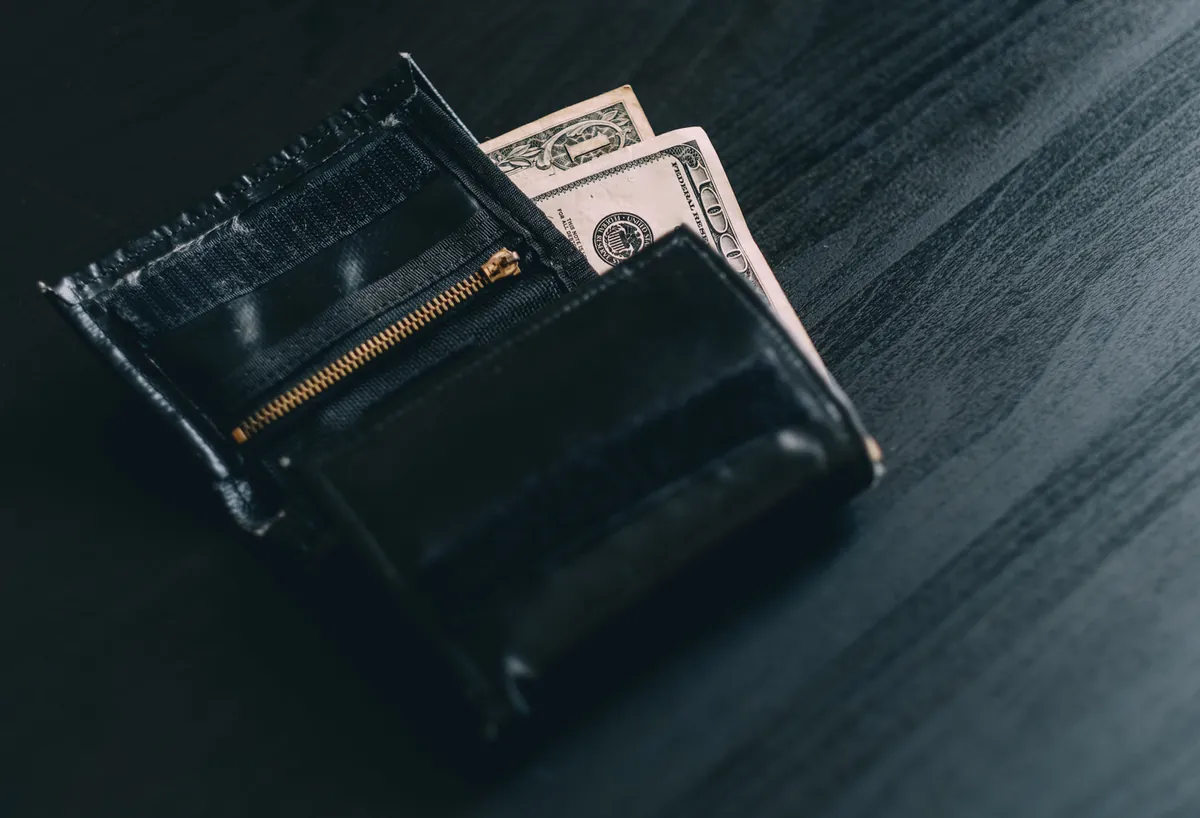
Look at the back pocket of your favourite jeans. If there's a faded rectangle worn into the denim, your men's wallet is too thick, and it's doing more damage than you think: it marks the fabric, spoils the line of a jacket and eventually splits at the fold. The cause is nearly always the same. We pick the wallet in the shop, empty and flat, then load it with twelve cards, three receipts and a loyalty card nobody has used since 2019.
What to keep in mind before buying:
- Count the cards you actually use: that number sets the format.
- Full-grain leather ages well; bonded leather flakes apart within two years.
- Stitching and edges say more about quality than the logo does.
- RFID blocking is a bonus, not a deciding factor.
- Fair budget: $45 to $130 (roughly €40 to €120) for a leather wallet that lasts ten years.
Which wallet format fits what you carry?
Before colour, before leather, take stock. Empty your current wallet and sort it: debit card, credit card, driver's licence, health insurance card, work badge, two or three loyalty cards. Most men find they use four to six cards out of the dozen they carry. The rest can live in an app or a drawer.
That number decides the format of your men's wallet, for a mechanical reason. A standard payment card measures 3.37 by 2.13 inches and is 0.03 inch (0.76 mm) thick, under the ID-1 format of ISO/IEC 7810. Ten cards already add up to almost a third of an inch of plastic, before the leather layers, the cash and the stitching. A ten-slot wallet will never be slim. That's geometry.
Cash matters too. US bills all share one size, about 6.14 by 2.61 inches, so a compact wallet folds them in half. Euro notes grow with their value, up to 153 mm long for the €200 note, which is why European long wallets run slightly larger.
| Format | Closed size | Realistic capacity | Best pocket | Who it suits |
|---|---|---|---|---|
| Card holder | 4 x 2.8 in | 4 to 6 cards, folded bills | Front pocket, shirt pocket | Card or phone payers |
| Classic bifold | 4.4 x 3.5 in | 6 to 8 cards, bills folded once | Front or back pocket, jacket | Everyday all-rounder |
| Trifold | 4.4 x 3.1 in | 8 to 10 cards | Bag, jacket | Men with lots of cards |
| Long (breast-pocket) wallet | 7.5 x 4 in | 10+ cards, flat bills | Inside jacket pocket | Daily suit wearers, travel |
| Zip-around with coin pouch | 4.7 x 4 in | 6 to 8 cards, coins | Bag | Frequent cash users |
Sizes vary by a few millimetres from one maker to the next: treat them as ballpark figures.
Card holder: enough for most men
If you pay by card or phone, a card holder does the whole job. Four slots, a centre pocket for a folded bill, and it disappears into the front pocket of jeans or chinos. It's also the easiest format to carry with slim trousers. Aluminium pop-up card cases have their fans: they protect cards well, but their hard corners wear through pocket linings.
Bifold: the compromise that holds up
The bifold is still the best-selling format, for good reasons. It takes cash, a folded receipt, a dry-cleaning ticket. Get one with six slots rather than eight: you would end up filling them all.
Full-grain, split or synthetic: what is the leather worth?
In the US, the FTC's guides for leather products ask sellers to disclose when a product is made of split, bonded or imitation leather. Even so, a "genuine leather" stamp says very little about quality. Between two wallets with the same label, the gap in lifespan is measured in years.
Full-grain leather keeps the original surface of the hide, with its pores and small irregularities. It's the toughest grade and the one that develops a patina. Corrected or top-grain leather is sanded and coated with a finish that evens out the look: it stays neat for a long time, but it never patinas and eventually peels at the folds. Split leather comes from the lower layer of the hide, weaker and often hidden under heavy pigment. As for bonded leather (shredded fibres glued together with resin), it starts flaking in year two. We would steer clear.
Tanning changes the character of the wallet. Vegetable-tanned leather is firm, darkens and shines with handling within a few months, but dislikes water and shows every scratch. Chrome tanning gives a supple, even leather that copes better with rain. The first appeals to patina lovers, the second to men who want an object that stays as bought.
Alternatives exist. Technical nylon and coated canvas shrug off almost anything and cost little; cork and plant-based leathers are improving. They rarely patina, but ballistic nylon will take years of back-pocket abuse without complaint.

The construction details that give quality away
Three things can be checked in ten seconds on any men's wallet, in a shop or when the parcel arrives.
Stitching first. Tight, even stitches, about 3 to 4 mm each, point to careful assembly. A saddle stitch, sewn by hand with two needles, holds even if one thread breaks; a machine lockstitch unravels from the broken point. On a $65 wallet, machine stitching is fine, as long as the thread is thick and waxed.
Edges next. Either folded and stitched, or dyed, sanded and burnished with wax: both methods work. Avoid raw-cut edges that feel rough, as they fray within months.
Finally, the card slots. Slide a card in: it should go in with slight resistance, no forcing. Too tight and it will annoy you daily; too loose and your cards will fall out in six months, once the leather has stretched.
Where to carry it: back pocket, jacket or bag?
The back pocket is the most common spot and the worst one. It wears the wallet out, warps your jeans, and sitting on a two-centimetre lump for a long drive gets uncomfortable fast. The basic rule: don't sit on your wallet.
With slim jeans, the front pocket takes a card holder, not a trifold. With a jacket, the inside pocket happily holds a slim bifold or a long wallet, as long as your phone and keys don't go in there too: the jacket hangs lopsided, and all the work of a well-cut suit collapses.
If you carry a bag every day, your options widen. A zip-around or long wallet fits in it, and your pockets stay flat. That's the best argument for picking the right everyday bag for men rather than stuffing your trousers.
Do you need an RFID-blocking wallet?
The question comes up with every purchase. Contactless cards use NFC, which can only be read at a distance of a few centimetres. In France, a contactless payment without a PIN is capped at €50 per transaction, and US card issuers offer zero-liability protection on fraudulent charges. The risk of skimming exists, but it stays small.
Blocking has a concrete downside: it also blocks your work badge and your transit card. You'll be pulling cards out at every turnstile. Our view: an RFID-blocking wallet makes sense if you travel often through crowded places; for ordinary city life, it isn't worth paying extra. If the model you like already has it, fine.
What is the best men's wallet for your lifestyle?
- Card-only, jeans every day: a full-grain card holder, four slots, front pocket.
- Office in a jacket, a little cash: a slim six-slot bifold in black or dark brown chrome-tanned leather.
- Suit every day: a long wallet in the inside pocket, bills flat, nothing in the trousers.
- Tradesman or frequent cash user: a zip-around with a coin pouch, in the bag.
- Frequent traveller: a bifold with shielded slots, plus a separate passport holder.
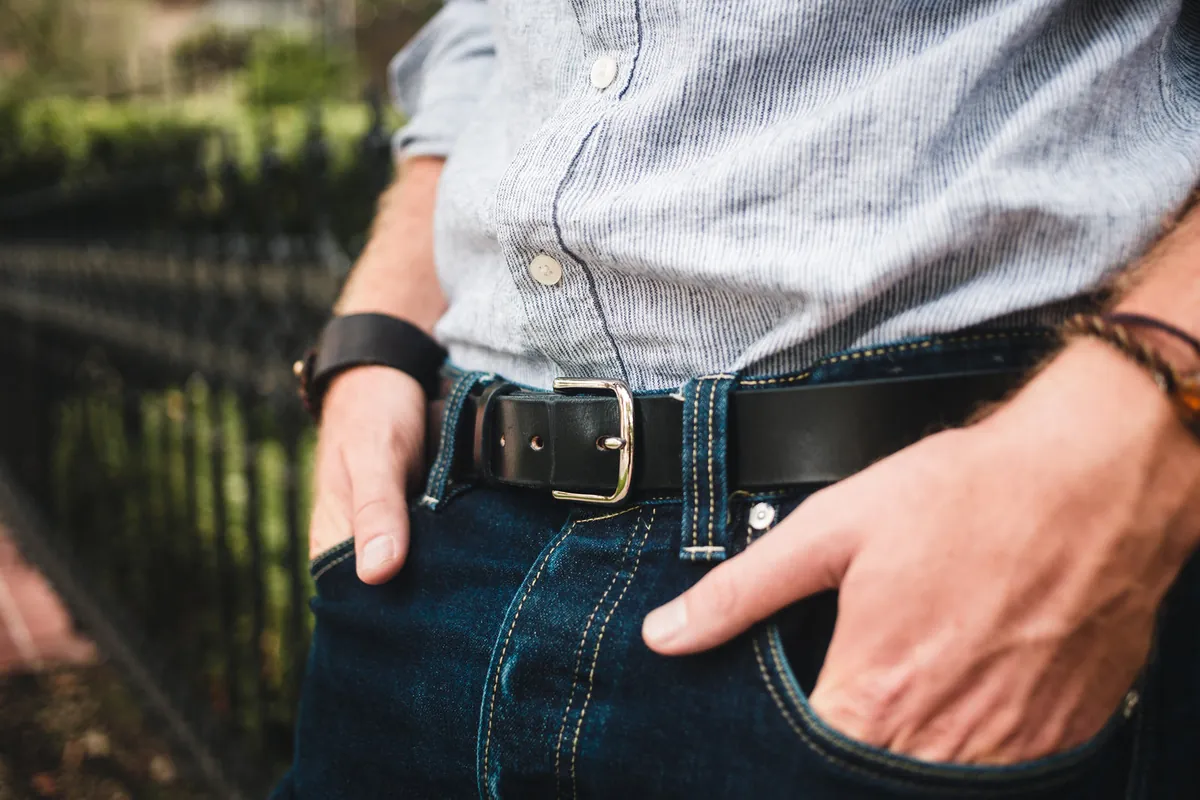
Colour follows the rest of the leather you wear. Black if your shoes and belt are black, dark brown or cognac if you live in brown derbies and a braided belt. The wallet rarely comes out, but when it does it's at the moment the bill arrives, right next to your watch: the same logic as choosing which watch to wear with which outfit. Navy and bottle green make good second wallets, more personal ones.
How much should you spend on a leather wallet?
Under $35 (about €30), the "leather" is almost always pigmented split or bonded material, with raw-cut edges. It'll do in a pinch. It won't last.
Between $45 and $130 (€40 to €120), you reach the heart of the market: full-grain or decent corrected leather, careful machine stitching, dyed edges. That's where we suggest buying a first men's wallet.
From $130 to $280 (€120 to €250), small leather workshops, many of them in Europe, offer European-tanned hides, hand stitching and often repairs. The difference shows after five years, not in the shop.
Above $330 (€300), the great leather-goods houses offer exceptional hides, flawless finishing and recognised saddlery expertise. You also pay for the name, which is a perfectly fair pleasure for an object you'll keep for fifteen years.
Last piece of advice: empty it once a month. A men's wallet is chosen for what you carry today; it only stays slim if you refuse to pile in what you no longer need. The rest of the wardrobe follows the same principle in our accessories and style section.